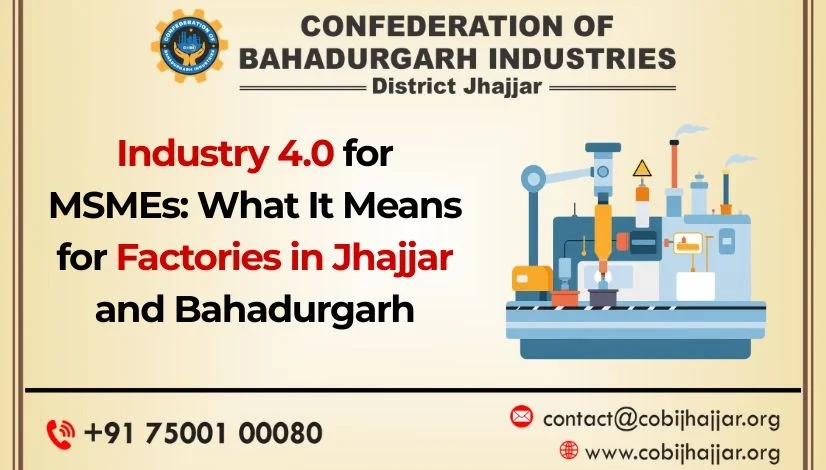
Industry 4.0 for MSMEs: What It Means for Factories in Jhajjar and Bahadurgarh
The term “Industry 4.0” has been circulating in industrial and policy circles for several years. For large corporations with dedicated technology budgets, it has already meant automation, data analytics, and smart manufacturing. But for the thousands of MSMEs operating in Jhajjar, Bahadurgarh, and across Haryana, it has often felt distant — a concept designed for larger players with deeper pockets.
That perception is changing rapidly. Industry 4.0 technologies are now accessible at a scale and cost that makes them relevant and practical for small and medium manufacturing units. This article explains what Industry 4.0 actually means in the context of your factory floor, which technologies are most immediately useful, and how government schemes can support your digital transition.
What is Industry 4.0?
Industry 4.0 refers to the fourth industrial revolution — the integration of digital technologies into manufacturing and industrial processes. Where the first revolution brought steam power, the second brought electricity, and the third brought computers and automation, the fourth brings connectivity, intelligence, and real-time data into every part of the production chain.
For a practical manufacturing unit, Industry 4.0 is not about replacing your entire operation overnight. It is about making incremental, targeted upgrades that improve efficiency, reduce waste, and give you better control over your processes.
The 5 Most Relevant Industry 4.0 Technologies for Jhajjar MSMEs
- IoT-Based Machine Monitoring Internet of Things (IoT) sensors can be installed on existing machinery to track parameters such as temperature, vibration, energy consumption, and output rates in real time. For a packaging unit or engineering goods manufacturer, this means early detection of machine faults before they become costly breakdowns. Many IoT monitoring systems are now available at ₹15,000–₹50,000 per machine — a fraction of what a single unplanned downtime event can cost.
- ERP Systems Designed for MSMEs Enterprise Resource Planning (ERP) software, once the domain of large companies, now comes in affordable cloud-based versions tailored for smaller manufacturers. Platforms such as Tally Prime, Zoho Manufacturing, and several India-built solutions allow you to integrate inventory, procurement, production scheduling, and invoicing in one system. This reduces manual errors, speeds up billing, and gives you a live picture of your business at any moment.
- Automated Quality Inspection Cameras paired with basic computer vision software can inspect products on the assembly line for defects at a speed and consistency no manual process can match. For industries supplying to automotive, electronics, or FMCG clients — where rejection rates directly impact contracts — this technology offers a rapid return on investment.
- Energy Management Systems Electricity costs are one of the largest operational expenses for Haryana’s industrial units, particularly since industrial tariff increases have been a recurring concern for COBI members. Smart energy management systems monitor consumption at the machine and line level, identify energy-wasting equipment, and can automate shut-off during non-productive periods. Several units in the NCR region have reported 12–18% reductions in their electricity bills after implementing basic energy monitoring.
- Digital Inventory and Warehouse Management Replacing manual stock registers with barcode or QR-code-based digital inventory systems eliminates stock discrepancies, reduces theft, and speeds up dispatch. For industries running thin margins, knowing exactly what is in stock — and what is not — in real time is a genuine competitive advantage.
Government Support Available for Your Digital Transition
The Government of India and the Haryana state government both offer financial support for MSMEs adopting technology upgrades.
Technology Upgradation Fund Scheme (TUFS) and MSME Technology Centre Support provide subsidies for machinery and technology modernisation. The Haryana MSME Policy includes provisions for capital subsidies on investments in plant and technology. Additionally, the Digital MSME Scheme under the Ministry of MSME provides cloud-computing tools free or at subsidised rates to eligible small manufacturers.
COBI actively tracks these schemes and facilitates member access to applications, documentation support, and interactions with the Haryana Industries & Commerce Department. Members are encouraged to reach out to COBI’s office to understand what they are currently eligible for.
Starting Small: A Practical Roadmap
The most common mistake businesses make when approaching Industry 4.0 is trying to do everything at once. A more sensible and financially manageable approach is to start with one high-impact, low-cost change:
Month 1–3: Implement a cloud-based ERP or accounting system. Get your data organised.
Month 4–6: Install IoT sensors on your 2–3 most critical or most problematic machines.
Month 7–12: Introduce digital inventory management and measure the impact on accuracy and dispatch speed.
Year 2: Evaluate energy management and quality inspection automation based on what your data is telling you.
This phased approach keeps capital requirements manageable while building your team’s comfort with digital tools progressively.
The Competitive Reality
Businesses in Jhajjar and Bahadurgarh increasingly supply to large corporations, export buyers, and e-commerce channels — all of whom are raising the bar on delivery timelines, quality standards, and traceability. An industry that cannot provide real-time production status or digital quality documentation will find itself at a disadvantage in contract renewals and new business acquisition.
Industry 4.0 is not a future consideration. For Jhajjar’s MSMEs, it is an immediate competitive requirement — and the good news is that entry points have never been more accessible or affordable.