CBAM Compliance for MSME Exporters: How Jhajjar & Bahadurgarh Industries Can Prepare for Global Green Trade Rules
For export-oriented factories in Haryana, the European Union’s Carbon Border Adjustment Mechanism is no longer a future policy discussion. The definitive CBAM regime started in 2026, and it can influence how EU buyers select suppliers for carbon-intensive products. This is why CBAM Compliance for MSME Exporters has become an important business-readiness topic for industries in Jhajjar, Bahadurgarh and nearby NCR manufacturing belts.
The key point is simple but important: Indian MSME exporters do not directly buy or surrender CBAM certificates under EU law. That responsibility generally sits with EU importers, authorised CBAM declarants or indirect customs representatives. However, Indian suppliers may still be asked to provide reliable emission data, product details, manufacturing records and documentation support. In that sense, CBAM Compliance for MSME Exporters is not just a legal issue; it is a market-access and buyer-confidence issue.
Table of Contents
- What is CBAM Compliance for MSME Exporters?
- Why CBAM matters for Jhajjar & Bahadurgarh industries
- Is CBAM directly applicable to Indian MSME exporters?
- CBAM-covered sectors and product categories
- 7 practical steps to prepare for CBAM in 2026
- Common mistakes MSMEs should avoid
- How COBI can support local industries
- FAQs
What is CBAM Compliance for MSME Exporters?
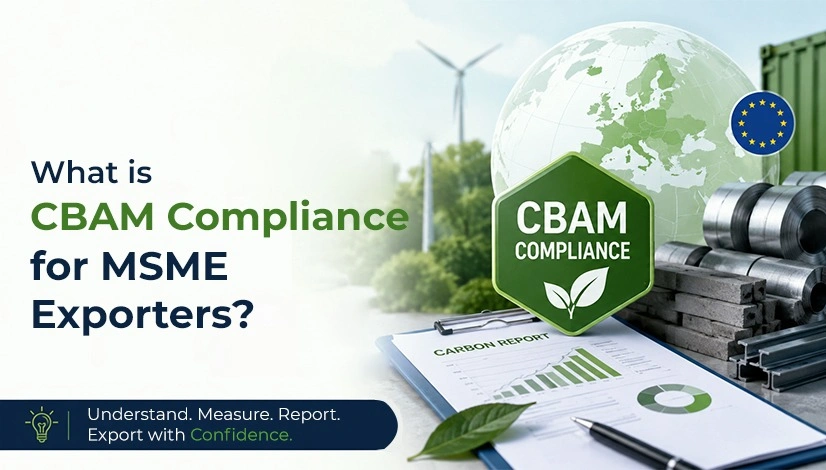
CBAM Compliance for MSME Exporters means preparing the information, systems and operational discipline required to support EU buyers under the Carbon Border Adjustment Mechanism. CBAM is designed to put a carbon price on selected imported goods entering the European Union so that imported carbon-intensive products face a carbon cost comparable to EU production.
In practical language, CBAM asks the supply chain to become more transparent about embedded emissions. Exporters may need to share details such as product classification, production route, electricity and fuel consumption, raw material input, process emissions and supporting records. For an MSME, the first objective is not to create complicated paperwork; it is to build a clean and traceable data system that can answer buyer questions confidently.
A simple background reference on the Carbon Border Adjustment Mechanism is available on Wikipedia, while news reports have also highlighted its impact on Indian steel exports to Europe. These references can help business owners understand why CBAM Compliance for MSME Exporters is now being discussed in trade and manufacturing circles.
Why CBAM Compliance for MSME Exporters Matters to Jhajjar & Bahadurgarh Industries
Jhajjar and Bahadurgarh have a strong base of manufacturing, fabrication, engineering, metal processing, packaging, machinery, auto components and industrial supply units. Even if a factory does not directly export to Europe, it may supply to a larger exporter, trading house, EPC company or OEM that sells to the EU market. In such cases, CBAM Compliance for MSME Exporters can become relevant through the supply chain.
For example, an MSME producing steel components may not be the direct EU exporter. However, if its buyer supplies CBAM-covered goods or assemblies to an EU customer, that buyer may ask for cleaner records, energy consumption data or material traceability. Factories that can provide this information quickly may look more reliable than suppliers that cannot support documentation.
This makes CBAM Compliance for MSME Exporters a strategic advantage. It can help local industries protect existing orders, become preferred suppliers, prepare for sustainability audits and reduce the risk of last-minute buyer pressure. The same work can also support other goals such as energy efficiency, lower fuel consumption, ESG readiness and improved operational discipline.
Is CBAM Directly Applicable to Indian MSME Exporters?
This section is very important for accuracy. CBAM obligations are primarily placed on EU importers or authorised CBAM declarants. EU importers bringing CBAM goods into the European Union above the applicable threshold need to follow the authorisation, declaration and certificate rules. Indian MSME exporters are not the party that directly purchases CBAM certificates from EU national authorities.
However, Indian exporters can still be affected commercially. EU buyers may request actual emissions data instead of accepting default values. If the data is incomplete, the importer may face higher compliance complexity or cost assumptions. Therefore, CBAM Compliance for MSME Exporters should be understood as a readiness exercise: Indian MSMEs support EU buyers with accurate data, documentation and cleaner production practices.
Another important update is the 50 tonnes annual mass-based threshold for CBAM goods. Companies importing less than 50 tonnes of CBAM-covered goods annually into the EU are generally exempt from CBAM obligations. But MSMEs should not assume automatic exemption because applicability depends on the buyer, importer, product classification, volume and EU customs position. The safest approach is to verify the product HS/CN codes and discuss documentation needs with the EU buyer.
CBAM-Covered Sectors and Product Categories
Current CBAM scope covers selected carbon-intensive goods and precursors in sectors such as cement, iron and steel, aluminium, fertilisers, electricity and hydrogen. For Jhajjar and Bahadurgarh industries, the most practical attention areas are likely to be iron and steel, aluminium and related supply chains.
CBAM Compliance for MSME Exporters should begin with product mapping. A factory should identify whether its finished goods, raw materials or buyer-specified components fall under CBAM-covered classifications. This is not a guesswork activity. The business should check the product code, buyer requirement, invoice description and export documentation before making any claim.
Factories that supply to domestic exporters should also ask whether their material goes into EU-bound products. This helps avoid surprises when buyers ask for carbon-related data close to shipment time.
7 Practical Steps for CBAM Compliance for MSME Exporters in 2026
1. Identify Product Codes and Buyer Markets
The first step in CBAM Compliance for MSME Exporters is to list all products supplied to export customers and match them with correct HS/CN codes. Also identify whether the buyer exports to the European Union. A small factory may discover that it is indirectly part of an EU supply chain even when it sells only within India.
2. Understand the Role of the EU Importer
Do not communicate that the Indian exporter has to buy CBAM certificates. The correct position is that the EU importer, authorised CBAM declarant or indirect customs representative handles EU-side CBAM certificate requirements. The Indian supplier’s role is to support documentation and emissions data where requested.
3. Start Basic Energy and Emission Data Collection
Good CBAM Compliance for MSME Exporters starts with simple operational records. Maintain monthly data for electricity, diesel, PNG, LPG, coal, furnace oil, process fuel, production volume and raw material use. Even if detailed carbon accounting is not yet available, disciplined data collection creates a foundation for future reporting.
4. Improve Energy Efficiency in Production
Reducing energy waste can reduce both operating cost and embedded emissions. Factories can review compressors, motors, furnaces, boilers, lighting, heat recovery, leakages and idle running. Energy efficiency is not only a sustainability point; it strengthens cost competitiveness and supports CBAM Compliance for MSME Exporters.
5. Build Material Traceability
MSMEs should maintain purchase records, mill test certificates, batch details, supplier invoices and production records wherever applicable. Traceability helps buyers connect the product with its material source, process route and quality documentation. This also improves audit readiness.
6. Prepare a Buyer Documentation Folder
Create a standard folder for EU-related buyers. It can include product codes, production process notes, energy consumption summaries, raw material sources, quality certificates, GST/export invoice copies and any third-party verification, if available. This makes CBAM Compliance for MSME Exporters easier to manage when a customer asks for information.
7. Train Sales, Accounts and Production Teams
CBAM is not only a compliance department issue. Sales teams should understand what not to promise, accounts teams should maintain invoice and purchase data, and production teams should record energy and material use correctly. A basic internal training session can prevent wrong communication and reduce client risk.
Common Mistakes MSMEs Should Avoid
The first mistake is saying that Indian MSME exporters must directly purchase CBAM certificates. This is not the correct general position. The second mistake is assuming that CBAM has no impact because the legal obligation is on the EU importer. In real business, buyer requirements travel down the supply chain.
The third mistake is relying only on verbal statements. Buyers and importers need records. The fourth mistake is ignoring energy efficiency until a buyer raises concern. The fifth mistake is using inaccurate product codes or incomplete invoices. CBAM Compliance for MSME Exporters should be handled as a structured documentation and improvement process, not as an emergency response.
How COBI Can Support Local Industries
COBI can play a useful role by creating awareness sessions, connecting industries with relevant experts, sharing updates through the Knowledge Series and helping members understand policy changes that may affect trade. For local factories, the objective should be practical readiness rather than fear. COBI’s industry network can help MSMEs discuss common buyer questions, energy-efficiency opportunities and documentation practices.
Members can also explore other COBI Knowledge Series articles for related topics such as industrial compliance, government schemes and energy efficiency. Industries that need guidance can connect with COBI through the official website for future programs, awareness sessions and member support.
Conclusion: CBAM Compliance for MSME Exporters is a Business Readiness Step
CBAM is valid, active and applicable in the European Union from 2026, but its direct compliance obligation generally belongs to EU importers and authorised CBAM declarants. For Indian MSMEs, the real impact comes through export buyers, supply-chain documentation, emission data requests and green trade expectations.
For Jhajjar and Bahadurgarh industries, CBAM compliance for MSME Exporters should be treated as an opportunity to become more transparent, efficient and future-ready. Factories that start product mapping, data collection, energy-efficiency improvements and buyer documentation early will be better prepared for the next phase of global trade.
FAQs on CBAM Compliance for MSME Exporters
Is CBAM applicable in Europe in 2026?
Yes. The European Union’s CBAM definitive regime started in 2026. It applies to selected carbon-intensive goods entering the EU, subject to applicable product classification, importer status and threshold rules.
Do Indian MSME exporters have to buy CBAM certificates?
Generally, no. CBAM certificates are bought and surrendered by EU importers or authorised CBAM declarants. Indian MSME exporters may need to provide emission data, product information and supporting documentation to their buyers.
Which sectors should Jhajjar and Bahadurgarh industries watch first?
Industries connected with iron and steel, aluminium, cement, fertilisers, electricity and hydrogen supply chains should pay attention first. Even indirect suppliers should check whether their products enter EU-bound supply chains.
How can an MSME start CBAM preparation?
Start by mapping product codes, identifying EU-linked buyers, maintaining energy and material records, improving energy efficiency and preparing a standard documentation folder for export customers.